Long before Blue Zone became a Netflix series, a diet or a very marketable shade of wellness, it was a demographic observation.
In 2004, researchers studying longevity in Sardinia identified a cluster of villages in the mountainous central-eastern part of the island where an unusually high proportion of people born between 1880 and 1900 had reached 100. What made Sardinia particularly interesting was the number of male centenarians. Normally, women considerably outnumber men at extreme ages; here, that gap was much smaller.
The researchers mapped the area, and the term Blue Zone was born. That original Sardinian Blue Zone is important to distinguish from the entire island. Sardinia itself is not one enormous longevity village. The strongest historical concentration was found in the mountainous interior, particularly the area associated with Ogliastra and neighbouring communities.
Since then, researchers have investigated exceptional longevity elsewhere in the world. A recent scientific review found the strongest demographic evidence for Ogliastra in Sardinia, Okinawa in Japan and Nicoya in Costa Rica. Other places frequently mentioned in popular Blue Zone discussions have varying levels of evidence, and the scientific classification continues to evolve. Already a bit more complicated than ‘drink red wine and live to 100’.
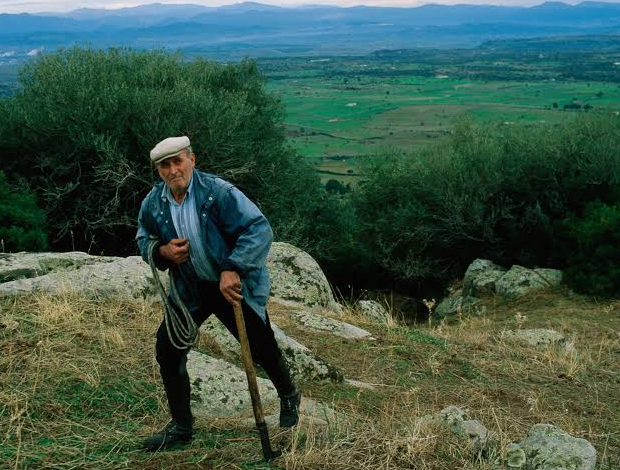
The interesting question is why certain populations age differently from the people living around them? Researchers still don’t have one answer. In Sardinia, studies have investigated genetics, geographical isolation, diet, physical activity, occupation, terrain, psychological wellbeing and social conditions. Pastoralism is particularly interesting: many men in the historical longevity region worked as shepherds or farmers, occupations involving considerable everyday movement across mountainous terrain.
Food and genes
Diet matters. The traditional Sardinian diet was shaped by a pastoral economy. Grains, vegetables, legumes and fruit were important, but so were locally produced sheep and goat products and other animal foods. Historical research even suggests that animal-derived foods were consumed more frequently in the longevity region than in other parts of Sardinia at the time.
Genetics are being studied too, but there is no discovered “Sardinian longevity gene” that explains the phenomenon. A 2024 study comparing nonagenarians from the Blue Zone with controls from a nearby Sardinian population found no association with 11 common genetic variants previously linked to successful ageing. In other words: there is no magic bean.
What becomes interesting is the interaction between biology, environment and lifestyle over decades. And Sardinia isn’t the only experiment. Okinawa gives us a completely different cultural context. Its historically long-lived population developed within Japanese food traditions, farming practices and social structures very different from Sardinia. Nicoya in Costa Rica gives us another.
And this is precisely why looking across longevity regions is useful: if populations eating different foods, speaking different languages and living thousands of kilometres apart show unusually high longevity, researchers can start asking whether there are broader patterns worth investigating.
But even here, we need some healthy scepticism. Blue Zones are not permanent. Some historically long-lived populations are losing their advantage. Recent research points to changes in Okinawa and Nicoya as younger generations adopt different lifestyles. That might actually be one of the most interesting findings of all.
A good question might be: What changes when the environment around them changes?
Health behavior versus a healthy environment
This is where Blue Zones become relevant even if living to 100 is nowhere on your vision board.
A shepherd walking through the mountains of Sardinia isn’t thinking: “Great, another 8,000 steps towards my cardiovascular health goals.” Movement was embedded in the day. Food was connected to local agriculture, availability and tradition. Social relationships were embedded in family and village structures. The physical environment demanded movement. And this distinction matters because modern wellness tends to focus heavily on individual behavior.
We sit for most of the day and schedule exercise. We spend hours looking at screens and schedule meditation. We eat quickly and then research supplements. We become overstimulated and download something to help us relax. Blue Zone research opens another possibility: perhaps health is influenced not only by the healthy things we consciously do, but by the environments and routines that quietly determine what we do all day.
Blue Zone vs Yoga
That is a much harder idea to sell in a bottle. Which brings us, strangely enough, to yoga. Because modern yoga has undergone its own interesting reduction. For many of us, yoga means a 60-minute physical class. And I love those 60 minutes. I teach them. But historically, yoga is an enormous collection of philosophical, contemplative and embodied traditions concerned with questions much larger than flexibility. In Patanjali’s well-known eight-limbed framework, asana is one limb.
There are also yama and niyama, concerned with conduct and how we relate to ourselves and the world; pranayama, working with breath; pratyahara, turning attention away from sensory input; dharana, concentration; dhyana, meditation; and samadhi, the culmination of that contemplative process.
And Patanjali represents only one strand in the much wider history of yoga. Yoga also asks how we direct attention. How we respond to our internal states. How we relate to other people. What we consume. How we breathe. How we live. This is where I find the meeting between yogic traditions and Blue Zone research genuinely interesting. Two completely different traditions can still make us curious about some of the same parts of being human.
Like movement. Yoga gives us a physical practice: learning to inhabit the body with more awareness, strength, mobility and attention. Traditional Sardinian life gives us another model: movement embedded in ordinary life. At ANIMA, we can practise both.
A morning Hatha practice might be followed by several hours walking through the Sardinian landscape. One is called yoga. One is called going for a hike. Your quadriceps are unlikely to care about the distinction.
Or food. Yogic traditions have long explored the relationship between food, mental state and practice. Concepts such as sattva eventually became connected with ideas about foods considered conducive to clarity, balance and contemplative practice. Sardinian food comes from a completely different tradition: pastoral, Mediterranean and deeply connected to the realities of the land. Trying to make them identical would be nonsense. Putting them into conversation is much more interesting.
What happens when food is considered part of how we feel rather than simply calories or macros?
What changes when preparing food takes time?
When we know where it came from?
When eating is also social?
Then there is rest. This may be where modern life and traditional contemplative practices have drifted furthest apart. Yoga developed sophisticated methods for working with attention, breath, sensory input and states of consciousness. Modern life developed push notifications. Pranayama, meditation, pratyahara and contemporary practices such as Yoga Nidra give us different ways to explore what happens when stimulation decreases and attention changes direction. But the environment matters too. A breathing technique can be useful, but so can walking outside, or having dinner with others, or having nowhere to be for two hours. So can fresh air, physical tiredness and going to bed early.
ANIMA Retreat
A retreat gives us enough time to explore both: the techniques and the conditions around them. This is why ANIMA isn’t really interested in the “secret to longevity”. We can’t reproduce the lives of Sardinian centenarians for a week. Their longevity developed within particular generations, landscapes, occupations, family structures, diets, genetics and historical circumstances. Some of the people studied were born in the nineteenth century. Their lives are not a wellness protocol waiting to be copied in 2027.
What we can do is become curious about the principles underneath all of this. And experience some of them rather than making another list about them. That is why ANIMA is a Blue Zone retreat rather than a Sardinian beach holiday with yoga added in the morning. We’ll practise asana, pranayama and meditation and explore some of the philosophy sitting behind them. We’ll hike. We’ll cook. We’ll meet people connected to Sardinian farming and pastoral traditions. We’ll eat together. And yes, Sardinia has beautiful beaches. But we’re going in April. Bring hiking shoes.
The experiment is what happens afterwards. Spending a week breathing in the Sardinian countryside is the easy part. The useful question is what survives the flight home. We don’t need Sardinia to give us the formula for living to 100. I’m much more interested in what it can teach us about living the years we actually have.